
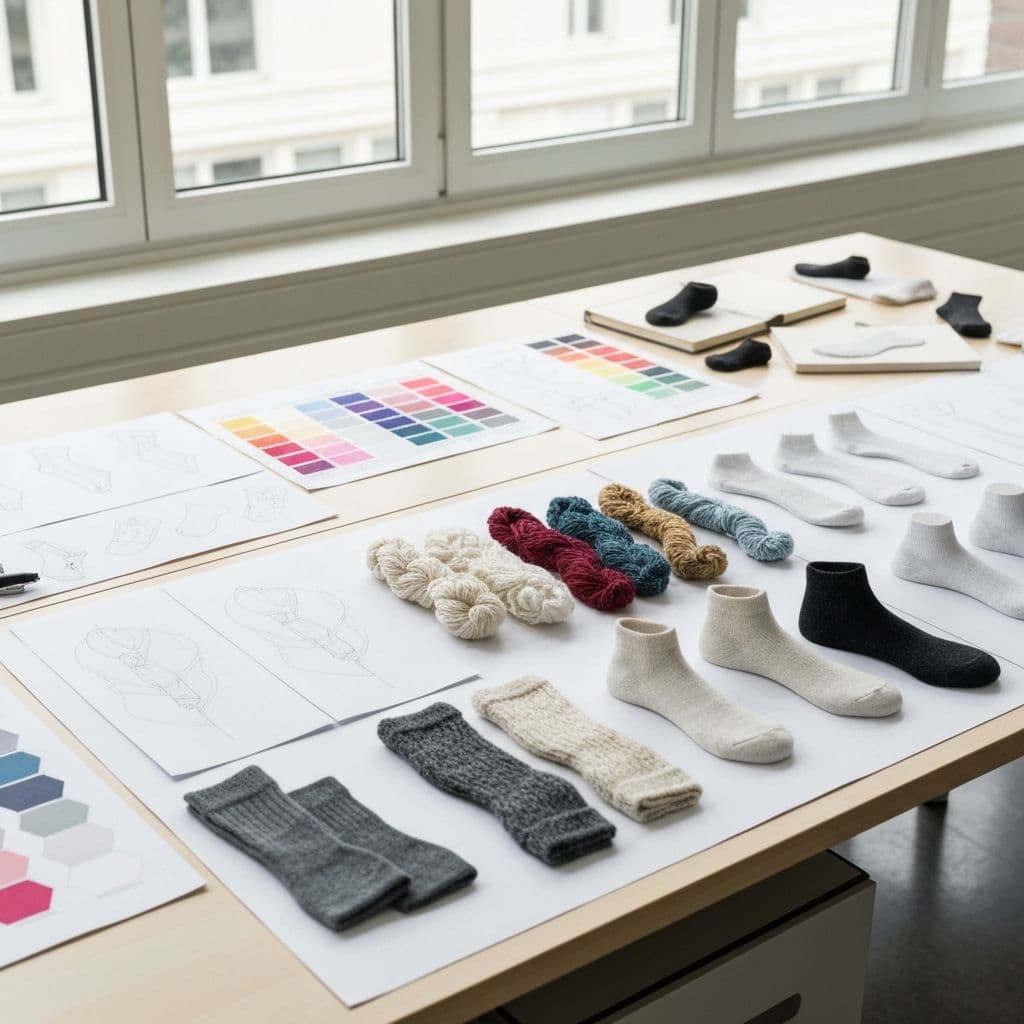
Successful sock product development requires careful planning across design, materials, manufacturing, and quality control. This comprehensive guide walks you through each stage of the development process, helping you create products that meet market demands while optimizing costs and timelines.
Phase 1: Market Research and Concept Development
Understanding Your Target Market
Before designing your sock line, thoroughly research your target audience:
- Demographics: Age, gender, income level, lifestyle
- Use cases: Athletic, casual, dress, specialty applications
- Price sensitivity: Budget, mid-range, or premium positioning
- Purchase drivers: Performance, style, comfort, sustainability
- Distribution channels: DTC e-commerce, retail, wholesale
Competitive Analysis
Study existing products in your target market segment:
- Identify top-selling sock brands and their positioning
- Analyze material compositions, features, and price points
- Find gaps in the market your products can fill
- Understand packaging, branding, and marketing approaches
Product Concept Definition
Document your product vision including:
- Product category: Athletic, casual, dress, compression, etc.
- Key features: Cushioning, compression, moisture-wicking, etc.
- Target price point: Retail and wholesale pricing goals
- SKU range: Sizes, colors, styles per collection
- Minimum order quantities: Initial and reorder volumes
Phase 2: Design and Specifications
Technical Design Elements
Sock design involves multiple technical considerations:
Construction Type:
- Terry loop: Cushioned interior for comfort and impact absorption
- Flat knit: Thin, lightweight construction for dress or liner socks
- Mesh panels: Ventilation zones for breathability
- Ribbed cuff: Stay-up power and fit
Length Options:
- No-show/invisible (below ankle)
- Ankle/low-cut (at or below ankle bone)
- Quarter (above ankle bone)
- Crew (mid-calf)
- Over-the-calf/knee-high
Functional Features:
- Arch support bands
- Reinforced heel and toe
- Seamless toe closure
- Y-heel construction
- Left/right foot specific design
- Compression zones
Material Selection
Choose materials based on your product positioning:
Performance Athletic: 65% Polyester, 28% Nylon, 7% Spandex
Casual Comfort: 80% Cotton, 17% Polyester, 3% Spandex
Premium Outdoor: 60% Merino Wool, 37% Nylon, 3% Spandex
Eco-Friendly: 75% Organic Cotton or Bamboo, 22% Recycled Nylon, 3% Spandex
Design Files and Tech Pack
Prepare comprehensive documentation for your manufacturer:
- Design artwork: Vector files (AI, EPS) with Pantone color references
- Technical drawings: Dimensions, construction details, feature placement
- Size specifications: Measurements for each size in your range
- Material specs: Yarn types, weights, blends by zone
- Packaging requirements: Labels, hang tags, packaging type
Phase 3: Sampling and Prototyping
Sample Types
Strike-off Sample: First prototype to verify design, colors, and construction. Usually 1-2 pairs.
Pre-production Sample (PPS): Refined sample after strike-off approval. Verifies all details before bulk.
Size Set Sample: Full size range samples to verify fit across all sizes.
Production Sample: Samples pulled from actual production run for final approval.
Sample Evaluation Checklist
- Color accuracy vs. Pantone references
- Design placement and proportions
- Material feel and quality
- Construction consistency
- Fit and sizing accuracy
- Functional features (cushioning, support, stretch)
- Label and packaging quality
Sample Timeline
- Strike-off: 7-14 days from approved artwork
- PPS after revisions: 5-10 days
- Size set: 7-14 days
- Total sampling phase: 3-6 weeks typical
Phase 4: Testing and Quality Assurance
Performance Testing
Verify your socks meet performance standards:
- Abrasion resistance: Martindale or Wyzenbeek testing
- Pilling resistance: ICI Pilling Box testing
- Color fastness: Washing, light, and perspiration tests
- Dimensional stability: Shrinkage after washing
- Stretch and recovery: Elasticity testing
- Moisture wicking: AATCC 195 testing
Safety and Compliance Testing
Ensure compliance with market requirements:
- Oeko-Tex Standard 100: Tests for harmful substances
- CPSIA (US): Lead and phthalate testing for children's products
- REACH (EU): Chemical safety compliance
- California Prop 65: If selling in California
Wear Testing
Conduct real-world testing before production:
- Distribute samples to target users for feedback
- Test across different activities and conditions
- Evaluate comfort, fit, and durability over time
- Gather insights for potential improvements
Phase 5: Production Planning
Order Quantities
Plan your production volumes carefully:
- Minimum Order Quantity (MOQ): Typically 100-500 pairs per style/color
- Size ratio: Standard split (e.g., S:10%, M:30%, L:40%, XL:20%)
- Color distribution: Based on sales projections
- Safety stock: Buffer for reorders and quality issues
Production Timeline
- Material sourcing: 1-2 weeks
- Production: 2-4 weeks depending on quantity
- Quality inspection: 2-3 days
- Packaging: 2-5 days
- Shipping: 2-5 weeks (sea) or 5-7 days (air)
- Total lead time: 6-12 weeks typical
Cost Structure
Understand your cost breakdown:
- Materials: 30-40% of FOB cost
- Labor: 25-35% of FOB cost
- Overhead: 15-25% of FOB cost
- Packaging: 5-10% of FOB cost
- Margin: 10-15% manufacturer margin
Phase 6: Quality Control During Production
Inspection Points
- Incoming material inspection: Verify yarn quality before production
- In-line inspection: Monitor quality during manufacturing
- Final inspection: AQL sampling before shipment
Common Quality Issues
- Color variation between production lots
- Size inconsistency within same size
- Dropped stitches or knitting defects
- Poor seam quality at toe closure
- Incorrect label or packaging
Phase 7: Launch and Iteration
Soft Launch Strategy
Consider a phased market introduction:
- Limited release to gather customer feedback
- Monitor reviews and return rates
- Identify any quality or fit issues
- Refine products before scaling
Continuous Improvement
- Track customer feedback and reviews
- Analyze return reasons and patterns
- Work with manufacturer on improvements
- Plan seasonal updates and new colorways
Product Development Timeline Summary
| Phase | Duration | Key Deliverables |
|---|---|---|
| Research & Concept | 2-4 weeks | Product brief, target specs |
| Design & Tech Pack | 1-2 weeks | Artwork, specifications |
| Sampling | 3-6 weeks | Approved samples |
| Testing | 1-2 weeks | Test reports, certifications |
| Production | 3-5 weeks | Finished goods |
| Shipping | 1-5 weeks | Delivered inventory |
Total timeline: 12-24 weeks from concept to delivery
Conclusion
Successful sock product development requires attention to detail across every phase - from initial market research through production and launch. Working with an experienced manufacturing partner who understands the process can significantly reduce risks and accelerate your time to market.
At VelonSocks, we support brands through every stage of product development, from concept consultation and sampling to full-scale production. Our low MOQ of 100 pairs makes it easy to test new products before committing to large volumes.